


General Export, Import and Transit Procedures
1. Classification of Goods for Import and Export.
Foreign trade operators need to know the categories under which their imports or exports fall so they can apply for the requisite permits where necessary.
As a member of SACU, Namibia applies a SACU common region–wide import and export management regime. According to the WTO import licensing agreement, imports are classified into three categories namely automatic, non-automatic and prohibited.
- Automatic licence imports is defined as import licensing where approval of the application is granted in all cases (automatic), and which is in accordance with the requirements of paragraph 2(a) of the WTO Import Licensing Agreement and procedures. For products that fall under automatic imports and exports, traders only need to declare them and complete the required customs clearing processes at the customs point of entry or exit. No prior permits are needed. More information on products falling under automatic licensing can be obtained at | Customs & Excise | NamRA
-
Restricted Goods- (Non-automatic import licensing). Restricted goods or non-automatic import license goods are items that are subject to certain conditions, regulations, or limitations on their importation or exportation, for example on production of a permit, certificate or letter of authority from the relevant government department, institution or body. These conditions may vary depending on factors such as the nature of the goods, their value, their intended use, and applicable trade agreements. Import and Export Control restrictions are applied to enforce health, environmental, security and safety, and technical standards that arise from domestic laws and international agreements that Namibia is a member of namely;
- Convention on International Trade in Endangered Species (CITES);
- Montreal Convention on the Emission of Ozone Depleting Substances;
- International Atomic Energy Agency (IAEA);
- International Organisation for Epizootics (IOE);
- World Intellectual Property Organisation (WIPO);
-
International Standards Organisation (ISO).
-
Examples of restricted goods include firearms, pharmaceuticals, some agricultural products, cultural artifacts, and endangered species.
-
Non-automatic import licensing procedures require that the importer/exporter should first obtain a permit from another regulatory entity before applying for a permit from the Ministry of Industrialisation and Trade.
-
Prohibited goods Prohibited goods are items that are not allowed to be imported or exported under any circumstances. These include items that are considered dangerous, illegal, or harmful to public health, safety, or morals. Examples of prohibited goods may include illegal drugs, counterfeit goods, weapons, hazardous chemicals, and certain types of wildlife products. There are no import or export procedures for prohibited goods because they are prohibited.
Prohibitions and restrictions are not limited to goods carried by travellers, but are applicable on all modalities of transport (road, rail, air, sea, post or other). This means that products subject to any prohibitions or restrictions will be subject to those no matter in what form of package or packaging they are imported or exported
The Namibia Revenue Authority (NamRA) provides detailed guidelines on prohibited and restricted imports, found at Prohibitions & Restrictions | Customs & Excise | NamRA
The full list of restricted and prohibited imports or exports is also found at Prohibited, restricted and counterfeit goods | South African Revenue Service (sars.gov.za)
2. Import of Goods Procedures
In terms of Section 9 of the Customs and Excise Act No. 20 of 1998, goods which are intended to be imported for use or consumption within the Customs territory must be declared for home use. They may be declared for home use either directly on importation or after another Customs procedure such as warehousing, temporary admission or Customs transit. the Namibia Revenue Authority (NamRA) provides detailed guidelines on importation of goods which can be found at Importation of Goods | Customs & Excise | NamRA
The main procedures for importing goods include the following.
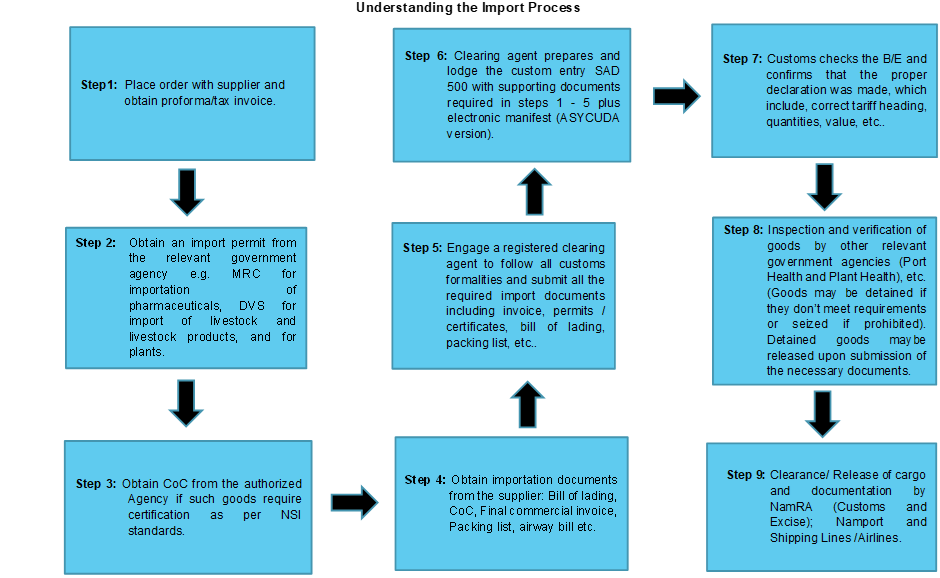
(i) Completion of Customs Declaration
NamRA is responsible for, inter alia, enforcing customs and excise legislation and the collection of revenues; facilitating the smooth movement and clearance of trade; the detection of illicit activities, including the cross-border movement of undeclared or under-declared goods and contraband such as controlled substances and drugs; and the preparation of trade statistics.
Every importer or exporter of goods must lodge a customs clearance declaration before the goods are imported to, or exported from, Namibia. After obtaining import licences from the relevant OMAs, importers are required to furnish import declarations in the prescribed format along with the Bill of Entry (SAD 500) to Customs and Excise as per Section 40 of the Customs and Excise Act. A Bill of Entry gives information on the exact nature, precise quantity, and value of goods that have landed or entered inwards in the country. Customs declaration forms can be found at Customs and Excise Forms | Customs & Excise | NamRA
ASYCUDA World in 2017 is used as customs operating system at all 29 customs and excise sites in the country. The system allows for direct trader input (DTI) by cargo carriers and freight forwarders and enables customs declarations to be processed electronically using a single administrative document for all imported goods (SAD 500/501). The use of clearing agents for import purposes, while not mandatory, is encouraged. The system allows for risk profiling and selectivity rules. Neither preshipment nor destination inspection of imports is required in Namibia.
The determination of the appropriate duties for the imports into Namibia can be found at this link. Legal-LPrim-CE-Sch1P1Chpt1-to-99-Schedule-No-1-Part-1-Chapters-1-to-99.pdf (sars.gov.za)
(ii) Summary of Import Documents
Customs and Excise Act 20 of 1998 mandates the following commercial documents for carrying out importing activities:
- Bill of lading or airway bill;
- Commercial invoice cum packing list; and
- Bill of entry.
Depending on the specific goods being imported, additional documents may be required. These could include:
- Certificate of origin;
- Inspection certificate; and
- Import license.
For second hand motor vehicles, the following documents are required.
- Invoice or pro-forma invoice with full details;
- Cancellation Certificate, Registration Certificate, Deregistration Certificate or Export Certificate;
- Bill of lading;
- Certified Copy ID/Passport/Permanent Resident Permit;
- Registration Certificate (CC, PTY Ltd, or Sole Trader); company registration Documents; Copy of owner’s ID or passport; deregistration certificate from country of export, which must be fully translated into English by a legitimate sworn translator; and
- Proof of payment/transfer of funds.
3. Procedures for applying an Import Permit (Non-automatic Imports)
The MIT is the primary contact point for enquiries regarding import and export licensing. Application forms for import permit must be submitted electronically to the Import, Export and Trade Measures Sub-Division, Directorate of International Trade: Ministry of Industrialisation and Trade along with all supporting required documents. Importers or exporters are required to submit their applications online at https://imex.mit.gov/na. Importers or exporters may also use the Ministry of Industrialisation, Trade and SME Development`s Regional Offices across the country to submit their applications but should note that processing of such applications and issuance of permits is only done at headquarters in Windhoek.
The Namibia Revenue Authority (NamRA) provides importation guidelines and details can be found at Importation of Goods | Customs & Excise | NamRA . Tariffs are found at Tariff Tool | Customs & Excise | NamRA
Step by step Import /Export Application Process Flow for Restricted Products

Details of application procedures and forms can be found at https://imex.mit.gov/na
(i) Requirements for obtaining import permits for controlled products (non-automatic permits)
Sections 2(1) (b) and 3 of the Import and Export Control Act, Act 30 of 1994 requires every importer and exporter whose goods are subject to import or export licensing to first obtain an import or export permit before importing into or exporting outside Namibia.
Requirements for a general import permit include the following
-
Fully completed import permit (IMEX online system);
-
Proof of citizenship or permanent residence (certified copy of ID/Passport);
-
Companies are required to provide proof of registration with the Registrar of Companies (certified copy of the Founding Statement/ Memorandum of Articles of Association /Sole Trader Defensive Certificate/ CM29);
-
Companies must only import products and related products, which are appearing in the principle line of business;
-
Pro – forma Invoice; and
-
Other accompanying documents for the consignment (that is, bill of lading and invoice).
- Second-hand clothing imports from SACU are limited to N$10 000 per individual per year.
Specific groups of products are subject to import or export control measures that are applied to enforce health, environmental, security and safety, and technical standards that arise from domestic laws and international agreements such as the Convention on International Trade in Endangered Species of Wild Fauna and Flora (CITES). The import or export control measures or restrictions are limited to those allowed under the relevant World Trade Organisation (WTO) Agreements. Table 1 provides a list of select groups of products subject to import controls and organisations, ministries and agencies responsible for processing and issuing the relevant import permits.
Applicants/importer/exporters may wish to check the full list of restricted and prohibited imports or exports at Prohibited, restricted and counterfeit goods | South African Revenue Service (sars.gov.za).
Table1. Select Controlled Products and Cross Border Regulatory Agencies issuing import permits
|
Product HS code |
Description |
Responsible OMAs |
|
0101; 0102; 0401; 0403; 0406; 0405; 0207 |
Live animals and genetic materials, Dairy products and poultry products; and meat, excluding game |
LLPB |
|
1005; 1005.10; 1104.23; 1001; 1101.00; 1104.21 |
Controlled agronomic and horticulture products |
NAB |
|
2601.00; 2603.00; 2606.00; 2607.00 |
Mineral Oils |
MME and MIT |
|
2608.00; 2616.00; Chapter 27 |
||
|
2816; 2817; 2818; 2820 |
Inorganic Chemicals |
MoHSS and MAWLR |
|
2901; 2902; 2903; 2904; 2905 |
Organic Chemicals |
MoHSS and MAWLR |
|
3003, 3004 |
Medicines |
MoHSS (Namibia Medicine Regulatory Council) |
|
3105; 3105 |
Fertilisers Chemicals |
MoHSS and MAWLR |
|
3204 ; 3301 |
Other Chemicals |
MoHSS |
|
3601.00; 3603.00; 3604.00 |
Chemicals |
MoHSS and MAWLR |
|
3701 |
Other chemicals |
MoHSS |
|
3901; 3902; 3904; 3906 |
Plastics, Polymers, Chemicals |
MoHSS |
|
7102.10; 7102.21; 7108.12; 7108.20; |
Diamond, gold, and other minerals |
Ministry of Mines and Energy |
|
7118.10; 7118.20 |
Coins; |
Bank of Namibia |
|
9301.00; 9302.00; |
Ministry of Safety and Security |
NB.
-
The process of gazetting controlled products for imports has commenced and the final list will be uploaded on this site once its finalised
-
Prior to applying for an import permit from MIT and depending on the product in question, applicants need to obtain import permits and support documentation from other departments (LLPB, Namboard, MAWLR- DVS, MEFT, National Heritage, MHAISS, NCRST, NMRC, MOHSS-NMRC, NCRST etc).
-
Unless it is indicated that imports require licences or permits from various authorities, such imports fall under the automatic category. In this case, no import permit is needed; importers simply declare the goods to customs at the point of entry.
-
Prohibited products are not allowed to be imported into Namibia.
(ii) Conditions subject to import permits
Import permits may be issued under the following conditions:
- Only goods of the class and kind described in the permit may be imported. Except where otherwise specified, the permit is intended for new goods only.
- The permit may not be transferred in any manner by the holder thereof to any other person or used to the benefit of any other person not named therein.
- The permit shall be valid for the calendar year for which it is issued and will be used for customs clearance of goods before 31 December of that year.
- The permit is issued without any amendments of any kind. If any unauthorised amendment appears therein, the permit will be invalid and will be confiscated by the Commissioner: Customs and Excise.
- The permit is not an exchange licence and only authorises the importation of the goods specified therein.
Details of applicable trade related Acts, measures, regulations, procedures, fees, forms, standards, applicable on export commodities are included on this page
4. Export of Goods Procedures
Exportation is the Customs procedure applicable to goods which leave the Customs territory and are intended to remain permanently/temporarily outside, for specific reasons. NamRA is responsible for collectingany applicable export duties and taxes, enforcing national legislation concerning export prohibitions and restrictions, and for verifying the particulars used to determine internal duties and taxes from which refunds can be allowed or for which exemption can be granted. NamRA provides detailed guidelines on exportation of goods which can be found at Exportation of Goods | Customs & Excise | NamRA
The legislation dealing with exports can be found in the following sections of the Customs Act:
- Delivery of bill of entry – Section 40(6)(a)
- Liability for duty – Section 18(1)(2)(3);40(6)(a)(i)
- Production of export – Section 40(6)(b)
- Proof of export – Section 18(4);
- Exports by post – Section 12(4)(a)
- Goods exported overland – Section 11(7)
- Time of export – Section 40(6) (a)
- Documents required for export – Section 40(6)(a)
- Diversion of exported goods ex warehouse – Section 18(8)
- Documentation export ex warehouse – Section 18(7)(b)
- Furnishing of security export ex warehouse – Section 18(5)
- Removal in transit/bond exports ex warehouse – Section 17
- Samples taken by Controller – Section 40(2)(c)
- Value for goods exported – Section 80(a)
Goods to be exported may also be subject to certain controls by competent authorities other than Customs, for example Agricultural, Mining, Fisheries, Trade etc.
5. Procedures for Applying for an Export Permit
a) Export Control Requirements
-
Export procedures are applicable to goods which leave Namibia and are intended to remain permanently/ temporarily outside the country, for specific reasons. Depending on the goods to be exported, different legislations may apply when exporting goods outside Namibia.
-
To export certain goods out of Namibia, you must have a permit ensuring that you comply with applicable export control measures. The export of some goods may be restricted to support local beneficiation or to assist local manufacturers to obtain raw materials before they are exported.
-
An export permit is required to ensure that goods exported by an individual or organisation comply with the provisions of international agreements.
-
Export permits also help to control the outflow of goods of a strategic nature or of smuggled and stolen goods.
-
All export clearances are to be handled in the same manner as the imports. In this respect, all supporting documents such as invoices and delivery notes should be attached to the Customs declaration form.
The Namibia Revenue Authority provides detailed exportation guidelines which are found at Exportation of Goods | Customs & Excise | NamRA
NB: On products that attract export duty/ levy, NamRA (Customs and Excise) collects such levies and ensures the enforcement of national legislations concerning export prohibitions and restrictions. Information about applicable export duties is available at Export Duties and Levies | South African Revenue Service (sars.gov.za)
NamRA (Customs and Excise) is also responsible for issuing preferential certificates of origin (CoO) while the Namibia Chamber of Commerce provides for the required non-preferential certification needed to verify that the national goods are being shipped outside of the country. These CoOs are issued through several Branch Offices which are strategically placed near our major ports and border crossings.
The policy that applies to the export of goods differs from sector to sector. Policy information regarding the export of specific goods can be obtained from the Ministry of Industrialisation and Trade, Trade Information Unit. Few products are subject to export control measures.
b) Some of the products subject to export control measures
Specific groups of products that require export permits and are also not automatically granted are shown in Table 2 below.
Table 2: Select Products that Require Export Permits
|
Product HS Code |
Product Description |
Institution responsible for issuing export license |
| 0101-0106 | Live animals and genetic materials | MAWLR and LLPB |
| 106.33. 0101 | All ostrich breeding materials (eggs, chicks, and birds); | MEFT |
| 0201 -0210 | Meat and other game products | MAWLR -(DVS) |
| 4101; 4106; 4113.90. | Hides and skins | MEFT |
| 0106; 0602 | Protected species (fauna/flora) in terms of the Convention on International Trade in Endangered Species (CITES); | MEFT |
| 3003, 3004 | Medicine and related substances; | MOHSS – NMRC |
| 2601; 2617.90; 2701; 2719; 2711.12; 2711.13.90; 2903 | Minerals | MME and MIT |
| 0106; 0602 | Plants, plant products and propagating materials | MAWLR and MEFT |
| 9301.00; 9302.00; | Firearms, explosives, etc.; | MHAISSS |
| 9701; 9703; 9706 | Works of art which have been in Namibia for more than 50 years; | National Heritage |
| .9701; 9703; 9706 | National monuments, archaeological findings, etc. | National Heritage. MEFT and NCRST |
In instances where export permits are required, the applicants should obtain support documentation from other departments (LLPB, Namboard, MAWLR- DVS, MEFT, National Heritage, MHAISS, NCRST, NMRC, MOHSS-NMRC, NCRST etc), depending on the product in question.
More information on products that require export permits can be obtained from Prohibited, restricted and counterfeit goods | South African Revenue Service (sars.gov.za)
Table 3: Step by Step Pre-export Procedure
|
Activity description |
Whom to contact |
Output |
|
|
Step 1 |
Ensure you have a trade license |
BIPA |
Trade License |
|
Step 2 |
Ensure you have secured an exporters’ code (if required) |
NamRA / OMA are responsible for regulating the product. |
Exporter code |
|
Ensure you have an export license |
OMAs with the mandate to regulate the product |
Export license |
|
|
Step 4 |
Ensure you have the relevant Permit / Certificate |
OMAs mandated to issue permits, e.g., MME: Minerals |
Permits/Certificates |
|
NPRA: Atomic substances |
|||
|
NMRC: Medicines |
|||
|
Agronomic: Board: Horticulture products |
|||
|
MAWLR:DVS; LLPB, etc -Live animals, poultry, plants, etc. |
|||
|
MIT -TPD: Industrial products and second goods |
|||
|
Step 5 |
Obtain the standard requirements of the buyer and make sure you comply to the specifications |
Buyer |
Standards |
|
Step 6 |
Determine and organize adequate fund |
Firm and Bank |
Funding |
NamRA (Customs and Excise) is responsible for preferential certificates of origin while the Namibia Chamber of Commerce provides for the required non-preferential certification needed to verify that the national goods are being shipped outside of the country. These CoOs are issued through several Branch Offices which are strategically placed near our major ports and border crossings.
Table 4; Before the Exporter sends the goods
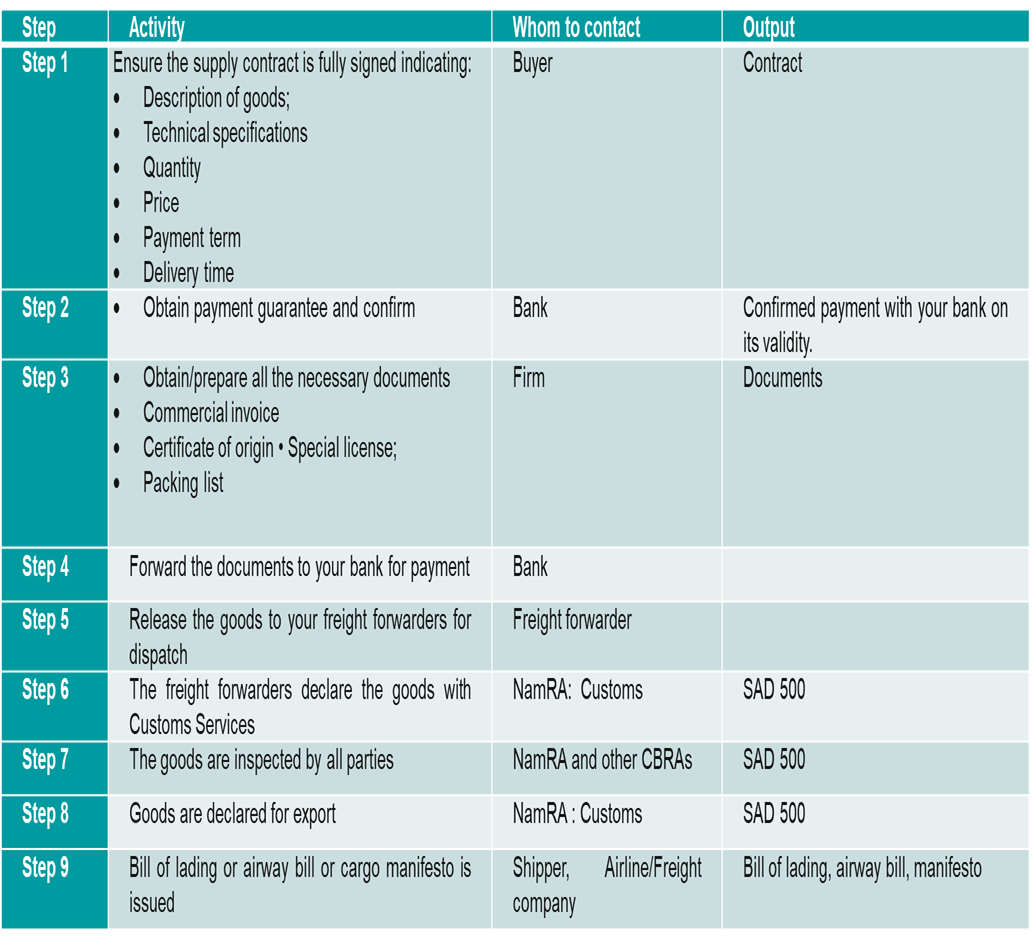
Details of applicable trade related Acts, measures, regulations, procedures, fees, forms, standards, applicable on export commodities are included on this page
6. Procedures for Applying for Rebate Permit
NamRA provides detailed guidelines general rebates, refunds and drawbacks which can be found at General Rebates, Refunds and Drawbacks | Customs & Excise | NamRA
a) General Information on Rebates
The main objective of rebate provisions in SACU is to provide a customs duty waiver on imported goods meant for industrial, manufacturing, agricultural production and for other general use by charity organizations, personal use, etc. For example, if the SACU market is unable to produce sufficient amounts of products required as an industrial or agricultural input for certain critical applications, or capital item, and such products attract an import duty, a rebate facility can be created to give relief to manufacturers when importing such products for production purposes. Schedule 3 Legal-LPrim-CE-Sch3-Schedule-No-3.pdf (sars.gov.za) of the Customs and Excise Act, Act 91 of 1964 provides for Industrial Rebates, while Schedule 4 Legal-LPrim-CE-Sch4-Schedule-No-4.pdf (sars.gov.za) of the same Act provides for General Rebates. In addition, Article 20 (2) of the SACU Agreement allows member states to apply for identical rebates, refunds or drawbacks of customs duty on imported goods which are provided for under Schedule 5. Legal-LPrim-CE-Sch5-Schedule-No-5.pdf (sars.gov.za)
The SACU Agreement makes provision under Articles 11 and 14 for SACU to establish a SACU Tariff Board and National Bodies respectively to deal with the administration of tariffs. Depending on the nature of the product, the rebate items can be administered by different OMAs in Namibia. Agricultural rebates for example under the EU-SADC EPA, SACU-MERCOSSUR, SACUM-UK EPA, etc. for products such as wheat, sugar and cheese are administered by MAWLR. The MIT administers industrial rebates under Schedule 3. On the other hand, NamRA (Customs and Excise) administers a number of general rebates under Schedule 4 .
However, some rebate items require the concurrence of other SACU Member States before they can be granted, that is, Rebate Item 412.11. The provision of this rebate item shall not apply in respect of any consignment, or quantity or class of goods unless the prior approval of the governments of Botswana, Eswatini, Lesotho, Namibia has been obtained for the application of such provisions in respect of every consignment or quantity or class of goods.
NamRA provides detailed guidelines general rebates, refunds and drawbacks which can be found at General Rebates, Refunds and Drawbacks | Customs & Excise | NamRA
b). How to Apply for Rebate Permits
Technically speaking, for industrial rebates, industries/companies are supposed to apply directly to International Trade Administration Commission (ITAC) since it has the special mandate to manage SACU tariff systems. Namibia does not have a national body to coordinate rebates and tariff processes and in the interim, until a body is institutionalised, the MIT, DTP (Import/Export) handles applications for industrial rebates (Schedule 3) and other general rebates under Schedule 4. The same application process for an import/export permit is followed. Supporting documents required will depend on the purpose of the rebate, for example for industrial rebates, the following documents are required: registration as a manufacturer, founding statement, invoice/quotation, packing list, etc.
For agricultural rebates, MAWLR sends out invitations to the private sector through media and, individual companies apply to the Ministry as per the terms and conditions.
7. Procedures Related to Goods in Transit
Section 2(3) of the Import and Export Control Act 30 of 1994 allows import/export permits to specify details such as the quantity or value of goods, price, import/export period, designated ports, countries of origin/destination, and the manner of import/export. The minister may also impose additional conditions, including those related to possession, ownership, disposal, or intended use of imported goods.
Sections 17(12) and 18A (7) of the Customs and Excise Act equally authorize the Commissioner to determine the routes and means of carriage of any goods removed in bond and to prescribe the permissible transit time.
A bond guarantee system operates on goods in transit through Namibia. Under the system, importers lodge a security to cover all charges, including customs duties, VAT, and levies. The bond may be redeemed once the goods have left Namibia. The security is currently being reviewed.
According to the Customs Cargo Processing Manual of 2014, Customs and Excise categorises the movement of goods in bond/ transit into four types namely:
-
Removal in bond/transit: from an office of entry to an office of exit (Direct removal transit);
-
Removal in bond/inward transit: from an office of entry to an inland Customs office;
-
Removal in bond/outward transit: from an inland Customs office to an office of exit; and
-
Removal in bond/transit: from one inland Customs office to another inland Customs Office.
More details regarding transit of second hand motor vehicles can be found here Public Notice - Procedures for Imported InTransit Second Hand Motor Vehicles | Announcements
Table 5: Step by Step Procedure for Transit Movement of Goods

Source: (Customs Cargo Processing Manual 2014)
8. Procedures Related to Temporary Importation
Temporary importation refers to a Customs procedure under which certain goods can be brought into Namibia without payment of import duties and taxes, subject to certain conditionsally relieved from. According to the amended Customs and Excise Cargo Processing Manual, 2014, there are three categories of temporary importations:
-
Goods temporarily admitted for processing, repair, cleaning, or reconditioning. Rebate Item 470.01 (A written statement on company letterhead from the person in Namibia to whom the goods will be processed setting forth the full circumstances must be attached to the entry. This provision is not limited to goods directly imported but may also be used for goods ex warehouse, ex transit, or ex Export Processing Zone).
-
Goods temporarily admitted for specific purposes, that is, trade shows or exhibitions. Rebate item 470.02 (Goods may temporarily be imported for repair, cleaning or reconditioning. Supporting documents from the consignor should provide sufficient particulars, number identifying marks and value of the goods so that they may be identified on re-exportation).
-
Goods temporarily imported for exportation in the same state. Rebate item 470.02 for repair, cleaning or reconditioning. Supporting documents from the consignor should provide sufficient particulars, number identifying marks and value of the goods so that they may be identified on re-exportation.
The time limit for goods admitted under temporary importation is six months, however extension may be granted upon request by the agent/importer and approval by the Commissioner of NamRA (Customs and Excise).
9. Procedures Related to Temporary Exportation
Temporary export procedures involve the temporary movement of goods out of Namibia’s customs territory for a specific period of time. This movement can be for various reasons such as for exhibition, repair testing, or processing. Temporary export procedures allow businesses to avoid paying duties and taxes on goods that are not intended for permanent export. The general outline of temporary export procedure is shown in Table 6 below.
Table 6. The General Outline of Temporary Export Procedure
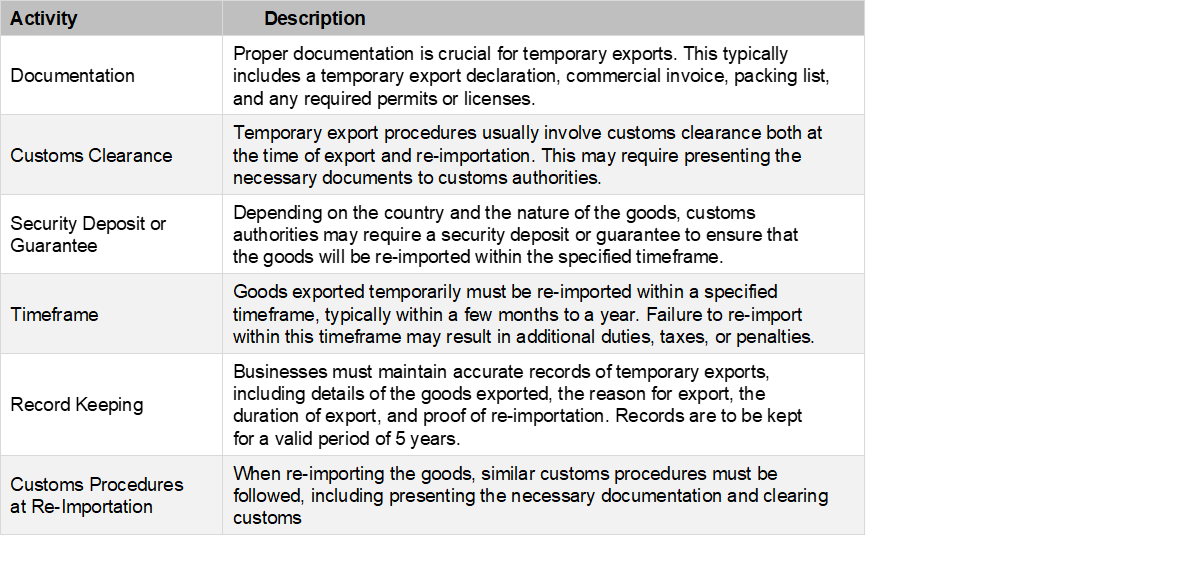
Temporary export procedures can vary from country to country and may be subject to specific regulations and requirements. It's essential for businesses engaging in temporary exports to familiarize themselves with the regulations of both the exporting and importing countries to ensure compliance and avoid any potential issues.
Details of application procedures and forms can be found at https://imex.mit.gov/na
More details of applicable trade related Acts, measures, regulations, procedures, fees, forms, standards, applicable on both import and export commodities are included on this page
Further details on import and export procedures can be obtained from:
- Sakeus Kapenda, +264 67 283 7373, Sakeus.Kapenda@mit.gov.na
- Lynnox Mwiya, Lynnox.Mwiya@mit.gov.na
- Selma Ugulu, +264 61 283 7286, Selma.Ugulu@mit.gov.na
- Etuna Sheya, +264 61 283 7252, Etuna.Sheya@mit.gov.na
- Elizabeth Kambala, +264 61 283 7309, Elizabeth.Kambala@mit.gov.na
Ministry of Industrialisation, Trade and SME Development Directorate of International Trade Import, Export and Trade Measures Private Bag 13340 Windhoek - Namibia Tel: +264 61 429200