


Rules of Origin in Namibia's Main Regional Trade Agreements (RTAs)
a) What are Rules of Origin?
- The purpose of rules of origin under each regional trade agreement RTA) is to ensure that goods entering a particular country from another member state within the RTA have actually been made or produced with sufficient local content (meet the expected originating criteria) to qualify for preferential tariff treatment.
- Rules of Origin are the criteria that are used to define where a product was made. The origin of a product is used to determine the import duty payable and whether it is subject to an antidumping or countervailing duty.
- Rules of origin ensure the preferential market access negotiated is granted to goods being imported or exported between trading partners in a preferential trading arrangement.
- Rules of origin also allow for the implementation of policies such as anti-dumping duties, safeguards and quotas.
- There are two categories of Rules of Origin namely non-preferential and preferential Rules of Origin.
- The non-preferential rules are applied for “Most-favoured Nation” (MFN) trade purposes (i.e. where goods are subject to the general rates of duty). As part of SACU, Namibia's non-preferential rules of origin contained in the Customs Act are modelled on South Africa's Act. A good is considered as having been produced or manufactured in any particular territory if at least 25% (or other percentage as determined by the Commissioner for Customs) of its production cost is represented by materials produced and labour performed in that territory, and if the last process in its production or manufacture has taken place in that territory.
- Preferential rules of origin are applied in the case of Free Trade Agreements and other preferential duty schemes. Namibia as part of SACU applies preferential rules of origin under the SADC Protocol on Trade; the EPA between the SADC EPA Group, and the European Union; the FTA between the European Free Trade Association (EFTA) States and SACU members; the SACU-Mercosur Preferential Trade Agreement; the FTA signed by SACU and Mozambique with the United Kingdom; and the African Continental Free Trade Agreement (AfCFTA). The purpose of rules of origin in these agreements is to ensure that goods entering a particular country from another member state within the RTA have actually been made or produced with sufficient local content (meet the expected originating criteria) to qualify for preferential tariff treatment. More information on these and other trade agreements can be found at https://namibiatradeportal.gov.na/market-access and also at Trade Agreements and Schedule 10.
- Generally, for a good to meet rules of origin, it should meet one of the following requirements (criteria):
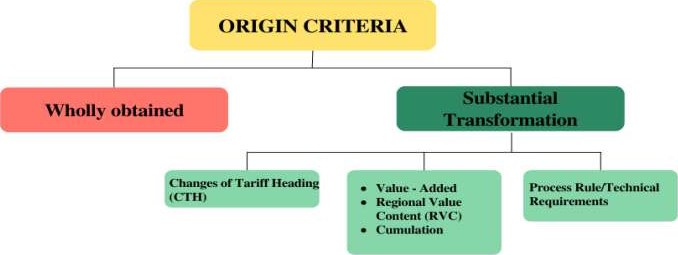
- A good is wholly obtained if produced entirely in the territory of one or more of the FTA countries. Many FTA defines 'wholly produced" as:
- Plants and vegetable products grown or harvested there
- Live animals born and raised there

- Products from live animals raised there
- Products of aquaculture where the fish, crustaceans and molluscs are born and raised there
- Substantial transformation means that the good has undergone a fundamental change (as a result of manufacturing or processing in the country claiming origin) - agreed value addition percentage or transformation that leads to a change in the HS classification code
- Cumulation provisions allow products originating from one member country to be considered as originating in another member country when determining if a good is able to meet a product-specific rule
All trade agreements follow a general approach to rules of origin except a few differences.
For further details on rules of origin, contact NamRA at +264(61) 2092047/2060 (Customs & Excise); https://www.namra.org.na
b) African Continental Free Trade Area (AfCFTA) Rules of Origin
In accordance with the AfCFTA trade regime, goods qualify for preferential tariff treatment if they originate in State Parties and when they are traded within the AfCFTA. In terms of Article 4 of Annex 2, a product shall be accepted as originating from a State Party if it has:
- been wholly obtained in that State Party within the meaning of Article 5 of Annex 2; or
- undergone substantial transformation in that State Party within the meaning of Article 6 of Annex 2
Details of the rules of origin under AfCFTA, are found at AfCFTA Rules of Origin - AfCFTA (au-afcfta.org).
The AfCFTA Rules of Origin Manual found at RoO Manual - English (au-afcfta.org) provides details of the application of these rules in determining the origin status of goods.
c) SADC Rules of Origin
The SADC Protocol on Trade, in Annex I provides that goods shall be accepted as eligible for preferential treatment when traded among SADC member States if they originate in Member States. In order to qualify for these benefits, goods must fit one of the following criteria:
- Wholly produced or obtained within a Member State. Items such as minerals, fish and livestock, fruit and vegetables, or products made with these locally-sourced items fit this criterion.
- Produced in a Member State using non-originated materials, but have been substantially processed within one.
- Changed tariff headings due to the processing that occurred in a Member State.
Goods that fall under SADC Rules of Origin are not subject to tariffs when being imported or exported within the Free Trade Area. Goods that meet all the requirements of SADC’s Rules of Origin are entitled to a certificate of origin, which allows holders to take advantage of the benefits of the Free Trade Area.
Namibia has been implementing the SADC E-Certificate of Origin (e-CoO) since December 2022. The e-CoO is an electronically processed certificate of origin issued by a competent or issuing authority of the exporting country attesting that goods declared by an exporter conform to the required rules of origin.
More details about the application of SADC Rules of origin, procedures of administering the rules and the institutional framework for the implementation rules can be found at Rules of Origin Exporters Guide Manual | SADC
d) Economic Partnership Agreement (EPA) between the European Union and the SADC EPA States Rules of Origin,
The protocol on rules of origin of the EU/SADC Economic Partnership Agreement stipulates that goods can be qualified as originating when they are either
- wholly obtained, as defined in article 7, or
- sufficiently worked or processed, as provided for in article 8 while taking into account the provisions of article 9 (Insufficient working or processing).
The Protocol also addresses rules of origin provisions on bilateral and diagonal cumulation, cumulation with materials subject to MFN duty free treatment in the EU, cumulation with materials originating in countries benefiting from duty-free quota-free access to the EU, territoriality and accounting segregation, all information about rules of procedures, notification of customs authorities among others.
Modalities for implementation of provisions of cumulation under EPA have been finalised and can now be used.
More details about the application of EU/SADC EPA Rules of origin, procedures of administering the rules and the institutional framework for the implementation rules can be found at SADC_Protocol-on-Rules-of-Origin.pdf (europa.eu) and at SADC-EU EPA Outreach - SADC-EU EPA: Protocol 1 on the Rules of Origin (sadc-epa-outreach.com)
e) Economic Partnership Agreement (EPA) between the UK and Southern African Customs Union Member States (SACU) and Mozambique (SACUM),
- The protocol on rules of origin provides that goods traded the Parties should meet originating criteria namely
- either wholly obtained or
- sufficiently processed for them to receive preferential duty treatment.
- To be considered sufficiently processed goods will need to meet the relevant product specific rule (PSR).
- To claim preferential rates for exports from SACUM countries to UK, the exporters need to fill in a EUR1 certificate of origin marked United Kingdom.
- The SACUM/ UK EPA also provides for cumulation with the European Union. This means that businesses can incorporate EU materials or processing into their exports to the UK or SACUM countries.
- The agreement also has cumulation provisions allowing use of materials from, and processing carried out in, the other countries and territories referenced provided the working or processing in Namibia goes beyond the minimal operations listed in the agreement and the other relevant conditions are fulfilled.
More details about the application of SADCUM/UK EPA Rules of origin, procedures of administering the rules and the institutional framework for the implementation rules can be found at Trade with Southern African Customs Union Member States and Mozambique (SACUM) - GOV.UK (www.gov.uk)
Apart from trade agreements, Namibia also benefits from other international instruments or agreements, such as the African Growth and Opportunity Act (AGOA) and the different Generalized Systems of Preferences (GSPs), with specific rules of origin . More information is available at Other International Agreements.